Your challenges
Your experts leave. Their know-how stays.
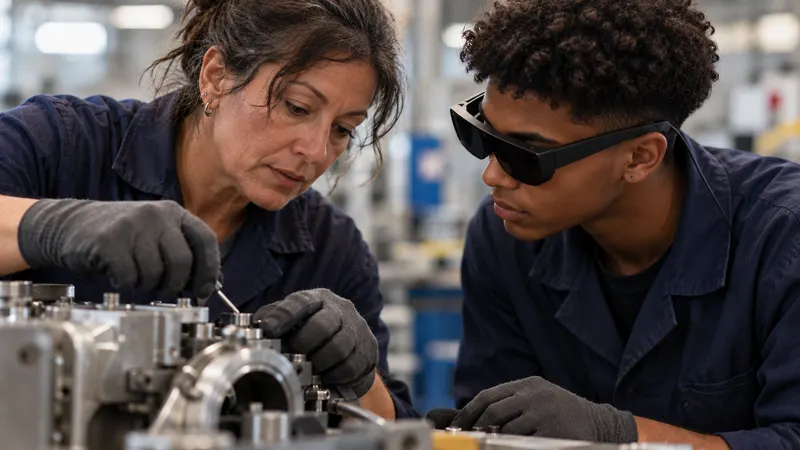
Procedures stay in the cabinets; the knack leaves with the person who has it. While your expert is still here, they can pass on their hands-on skill on the real equipment, in a few minutes, without anything leaving your site.
The situation
Hands-on skill is the first to go.
In France: Industry must absorb one million retirements by 20301, while 43.8% of recruitment plans are considered difficult2.
Large numbers of departures
In France: The metalworking industry alone accounts for 40,000 retirements a year3. In the armed forces as in schools, key trainers will leave in the coming years.
Knowledge that is hard to write down
The movement, the order of operations, the feel: the expert does not describe them, they do them. Interviewed in an office, they recount the official procedure.
Less experienced newcomers
In 2025, 74% of recruiters facing shortages accepted less experienced candidates2: those arriving have more to learn, just as those who know are leaving.
An expert who is already overloaded
They will not write a procedure: they do not have the time. But they can show their hands-on skill, while working.
What SHIFT89 changes
The expert’s hands-on skill, kept on the equipment before they leave.
A few minutes
The expert passes on a procedure in a few minutes, while working: no writing, no filming.
Learn moreHands-free
They create while performing the task, glasses or headset on, even if they are not comfortable with computers.
Learn moreOn the real equipment
Their procedure, their points of attention and their tips stay attached to the equipment, for whoever comes next.
Learn more100% offline
This know-how is your asset: it stays on your equipment, never in a cloud.
Learn more
Our approach
First, understand how a hands-on skill is learnt. Only then, the tool.
Before designing our tool, we studied how people learn to do with their hands what they cannot yet do.
A learning method from our research work
With research laboratories, we studied how people learn a task they don’t know how to do, in a constrained environment. The aim is not to make people act like robots: it is for everyone to understand, remember and own the skill. This method is validated by 5 industrial PhD theses.
A creation method within every expert’s reach
The real challenge is creation: experts don’t have time, and not all of them are comfortable with digital tools. They create their own tutorials, very quickly, with the help of the built-in AI, and these tutorials apply the learning method without them needing to know it.
The tool we wish we’d had
As former industry professionals, we know every second counts: the expert’s time must be kept as short as possible. We also know the value of trade or defence secrets: everything works offline, without compromise, artificial intelligence included, right down to translating a tutorial in a few seconds.
The result: tutorials created in a few minutes, that really make people learn.
Measured results
What our deployments have measured.
- 1 minTo create an instructionBy the expert, on the real equipment, with no writing or editing (measured in our deployments)
- × 2Train twice as fast, autonomouslyMeasured in our deployments, at a tier-one automotive supplier
- +90%RetentionAccording to our method, validated by 5 industrial PhD theses
Frequently asked questions
Your questions.
Where to start before an expert leaves?
Identify the tasks that are rare, risky or known by only one person, and have them passed on first, at the workstation, while working, while the expert is still here.
Our expert is not comfortable with computers. Is that a problem?
No. They create while performing the task, glasses or headset on, without writing anything. In our deployments, 8 trainers were operational after one day.
What happens to the tutorial when the equipment changes?
It is even quicker to edit than to create: a few minutes are enough to update it.
Your other challenges
- Your challenges: overview
- High staff turnover
- Train young people
- Mixed skill levels
- Not enough trainers
- No time to write procedures
- Training is expensive
- Train more to ramp up production
- Improve your teams’ safety
- Train your customers
- Don’t miss out
- Industry 4.0, profitable fast
- Your HoloLens 2 solution reaching end of life
- HoloLens 2 headsets gathering dust
Sources
- Le Journal des Entreprises, presentation of the national roadmap for employment and attractiveness in industry (21/04/2026) — www.lejournaldesentreprises.com/article/le-gouvernement-devoile-une-feuille-de-route-pour-accelerer-les-recrutements-dans-lindustrie-2141471 (new window) (consulted on 26/10/2026)
- France Travail, Besoins en main-d’œuvre (BMO) 2026 survey, published on 21/04/2026 — www.francetravail.fr/candidat/decouvrir-le-marche-du-travail/besoins-en-main-doeuvre.html (new window) (consulted on 26/10/2026)
- Observatoire de la métallurgie, prospective des besoins en recrutement (September 2024) — www.observatoire-metallurgie.fr/sites/default/files/2024-10/obsm_prospective_recrutement-221024-v3_pap.pdf (new window) (consulted on 26/10/2026)
Your best expert’s know-how deserves to be preserved.
A 30-minute to 2-hour demo, on one or more of your real cases, in your environment, with your teams. Just agree on a date.
or write to us