Deployment
8 trainers operational after one day
In our deployments, one day of training is enough: trainers create their first tutorial that same afternoon, then work on their own from the next day.
Result: 8 trainers operational at D+1.
Your challenges
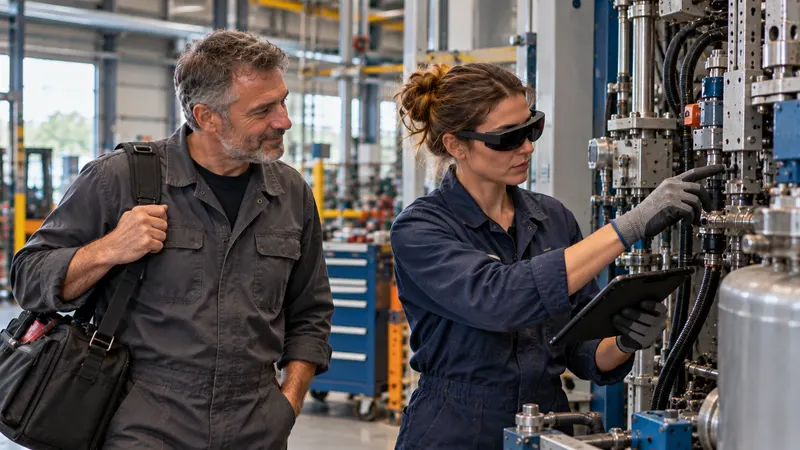
Temporary workers, seasonal staff, new postings: every newcomer starts from scratch, and each time an expert stops to train them. That expert's know-how stays attached to the equipment: the newcomer follows it step by step, hands-free, on the real equipment.
The situation
In France: The metalworking industry alone employs 110,000 to 120,000 temporary workers, around 8% of its workforce1. Each of them must learn their workstation quickly, sometimes in another language.
In road transport, including logistics, staff turnover reaches 17%2. Onboarding newcomers never stops.
Among low-skilled workers in the food industry, 46.8% of recruitment projects are seasonal3. Each peak brings new faces to train.
In the armed forces, the annual posting plan moves everyone to a new post every two or three years. Know-how must stay in the unit, even more than in industry.
An operator who changes workstation also starts from scratch. And each time, an expert leaves their work to show the same tasks.
What SHIFT89 changes
Your expert passes on each procedure once, in a few minutes. They no longer have to repeat it for every newcomer.
Learn moreThe procedure stays on the equipment: the temporary worker, the seasonal worker or the newly posted person finds it at their workstation and follows it step by step.
Learn moreEach instruction can be translated and read in the newcomer’s language, by an artificial intelligence that runs at your site, offline.
Learn moreA quiz checks that the newcomer has understood; you track who has learned which procedure, workstation by workstation.
Learn moreOur approach
Before designing our tool, we studied how people learn to do with their hands what they cannot yet do.
With research laboratories, we studied how people learn a task they don’t know how to do, in a constrained environment. The aim is not to make people act like robots: it is for everyone to understand, remember and own the skill. This method is validated by 5 industrial PhD theses.
The real challenge is creation: experts don’t have time, and not all of them are comfortable with digital tools. They create their own tutorials, very quickly, with the help of the built-in AI, and these tutorials apply the learning method without them needing to know it.
As former industry professionals, we know every second counts: the expert’s time must be kept as short as possible. We also know the value of trade or defence secrets: everything works offline, without compromise, artificial intelligence included, right down to translating a tutorial in a few seconds.
The result: tutorials created in a few minutes, that really make people learn.
At your site
The temporary worker arriving on Monday, the seasonal worker for the summer peak, the multi-skilled operator changing lines: each one follows your best expert’s procedure, on the machine.
IndustryThe workshop chief who is posted elsewhere leaves their procedures on the equipment; their successor finds them on arrival. Know-how stays in the unit.
DefenceEvery new school year, a new intake discovers the technical training area: last year’s tutorials are already waiting for them.
SchoolsMeasured results
Deployment
In our deployments, one day of training is enough: trainers create their first tutorial that same afternoon, then work on their own from the next day.
Result: 8 trainers operational at D+1.
Frequently asked questions
Yes, precisely: the tutorial is created once and serves every newcomer. The more your teams rotate, the more useful it is.
Each instruction can be translated and read in the newcomer’s language, by an artificial intelligence that runs at your site, offline.
On the contrary: the tutorial stays in the unit when the post holder is posted elsewhere. Their successor finds it on the equipment, and the procedure does not start from scratch again.
A 30-minute to 2-hour demo, on one or more of your real cases, in your environment, with your teams. Just agree on a date.
or write to us