Your challenges
Learners with increasingly mixed ability levels? Help more people succeed.
Within the same class or team, the gaps in know-how and soft skills are much wider than a few decades ago. Supporting those who need it most takes time, and that time is in short supply. The most confident, usually 50 to 70% of the group, learn the procedure on their own, guided on the real equipment: your trainers finally have time to support the others.
The situation
Wider gaps than before, in every group.
We hear it everywhere: in vocational high schools, industrial and military training centres, factories.
Gaps in know-how
In the same group, some already have the skill, others are discovering the tool. Yet they all follow the same session.
Gaps in soft skills
Autonomy, concentration, attitude to instructions and to safety: from one learner to the next, the need for support is completely different.
Support that takes time
Supporting the one who needs it most ties up the trainer for a long time. Meanwhile, they are not with the others.
A single pace for the whole group
The same demonstration for everyone: too slow for some, too fast for others.
Our answer
The most confident move ahead on their own. The trainer goes to those who need them.
Most of the group, working on their own
The most confident, usually 50 to 70% of the group, learn the procedure step by step, guided on the real equipment, without waiting for the trainer.
Time for the others
The trainer is no longer tied up with repeated demonstrations: they give personalized support to those who need it most.
More people succeeding
Everyone gets the support they need: some progress on their own, others are helped at the right moment.
What SHIFT89 changes
What lets the most confident move ahead on their own.
On the real equipment
The instruction appears on the equipment, where action is needed: the learner does not wait to be shown.
Learn moreHands-free
With both hands on the tool, they really practise, and review the expert's procedure as many times as needed.
Learn moreOffline AI
The instruction read aloud, and translated if needed: those less comfortable with reading move ahead too.
Learn moreVerified learning
A quiz checks what has been learnt; the trainer sees who is struggling, and on which step, and knows whom to go to.
Learn more
Our approach
First, understand how a hands-on skill is learnt. Only then, the tool.
Before designing our tool, we studied how people learn to do with their hands what they cannot yet do.
A learning method from our research work
With research laboratories, we studied how people learn a task they don’t know how to do, in a constrained environment. The aim is not to make people act like robots: it is for everyone to understand, remember and own the skill. This method is validated by 5 industrial PhD theses.
A creation method within every expert’s reach
The real challenge is creation: experts don’t have time, and not all of them are comfortable with digital tools. They create their own tutorials, very quickly, with the help of the built-in AI, and these tutorials apply the learning method without them needing to know it.
The tool we wish we’d had
As former industry professionals, we know every second counts: the expert’s time must be kept as short as possible. We also know the value of trade or defence secrets: everything works offline, without compromise, artificial intelligence included, right down to translating a tutorial in a few seconds.
The result: tutorials created in a few minutes, that really make people learn.
At your site
The same situation, wherever hands-on skills are taught.
In vocational high schools
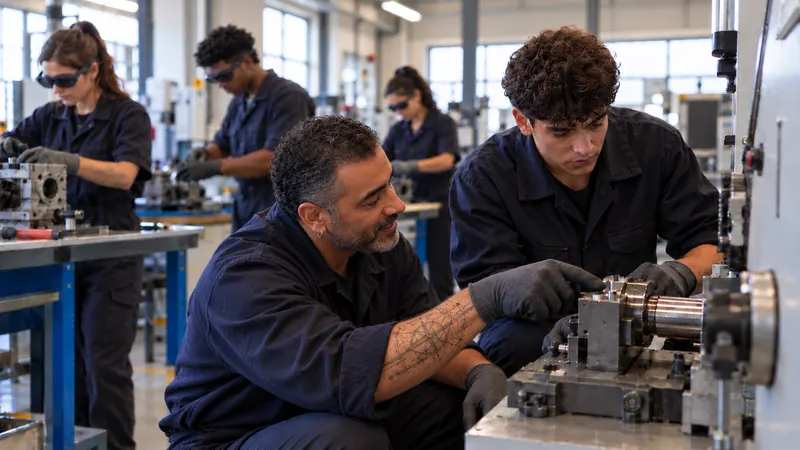
While a large part of the class practises, guided in the technical training area, you support the students who need you.
In apprenticeship training centres and industrial training centres
Apprentices, employees, adults retraining: very different backgrounds in the same group. Everyone progresses, and the trainer goes where it counts.
In military schools
A whole intake practises on the real equipment, while the instructor supports those who need it most.
Military schoolsIn industry
Newcomers, temporary workers, work-study trainees: the most autonomous train at the workstation, and the mentor helps the others.
IndustryIn the field
More time for those who need it.
Your trainers remain essential: their time goes where it counts.
- 50 to 70%Of the group trained on their ownThe most confident, usually
- ÷ 5Trainers and mentors tied up5 times fewer, measured in our deployments
- × 2Train twice as fast, autonomouslyMeasured in our deployments, at a tier-one automotive supplier
Frequently asked questions
Your questions.
Are struggling learners left behind?
No, quite the opposite: they gain the most. Freed from repeated demonstrations, the trainer finally has time to give them personalized support.
Does the tutorial replace the trainer?
No, quite the opposite. It is your trainers who create, improve and keep the tutorials alive.
The tutorial then takes care of repeating the procedure for the most confident. The time freed up goes to those who need it most, so that more of them succeed.
The tutorial trains; it replaces neither assessment nor authorization.
Do you need one device per learner?
Not necessarily. We recommend the right number of glasses or headsets for your groups and workstations, based on your context and use cases: no more, no less.
Your other challenges
- Your challenges: overview
- Your experts are leaving, taking their know-how with them
- High staff turnover
- Train young people
- Not enough trainers
- No time to write procedures
- Training is expensive
- Train more to ramp up production
- Improve your teams’ safety
- Train your customers
- Don’t miss out
- Industry 4.0, profitable fast
- Your HoloLens 2 solution reaching end of life
- HoloLens 2 headsets gathering dust
Help more people succeed.
A 30-minute to 2-hour demo, on one or more of your real cases, in your environment, with your teams. Just agree on a date.
or write to us