Your challenges
Training that young people enjoy, and remember.
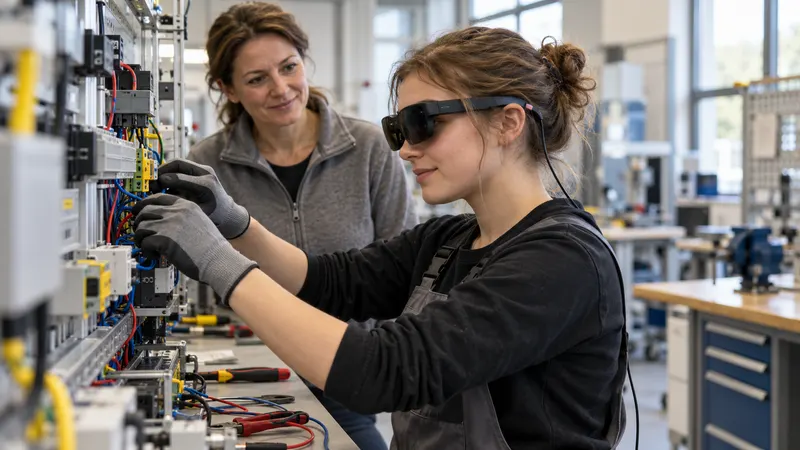
It is the main reason our customers choose us. A real machine, glasses or a headset, a first task done right: every young person learns by doing, guided step by step, at their own pace. And what they have done with their hands, they remember.
The situation
Trades to make attractive, skills to learn fast.
In France: The national roadmap for employment and attractiveness in industry targets 600,000 recruitments from 20261. First you need to make people want to join, then train them fast.
Shortage occupations
Hands-on trades are among the hardest to fill: 80.6% of recruitment projects are considered difficult for machining equipment operators, and 77.7% in boilermaking and sheet metal work2.
Recruits who need more training
In 2025, 74% of recruiters facing shortages accepted less experienced candidates3. Young recruits have more to learn, and fast.
Large numbers of students
In France: 661,631 students are on the vocational track at the start of the 2025 school year4. Each one must get on the equipment, and practise.
In the armed forces, a demanding life
Military life asks a lot, often far from loved ones. To attract younger generations and keep them, training must be effective and attractive.
For your trainers and mentors
Our tutorials do not replace your trainers and mentors. They multiply their reach.
They are the ones who create them
Your trainers and mentors create, improve and keep the tutorials alive.
Time for every young person
The tutorial takes over the repetition of the task: they deal with increasingly mixed levels and give tailored support to those who need it, helping more of them succeed.
Their know-how stays
Your training standard captures the best of your past, present and future trainers and mentors.
What SHIFT89 changes
They learn by doing, on the real equipment, and they remember.
On the real equipment
The instruction appears on the machine itself: the young person learns by doing, not by reading a sheet.
Learn moreHands-free
Both hands on the tool, guided step by step, everyone progresses at their own pace, without worrying about disturbing a senior colleague.
Learn moreVerified learning
A quiz checks what has been understood; the trainer sees who hesitates, and at which step, to help at the right moment.
Learn more100% offline
No online account, no learner data outside your walls: nothing to ask of the IT department.
Learn more
Our approach
First, understand how a hands-on skill is learnt. Only then, the tool.
Before designing our tool, we studied how people learn to do with their hands what they cannot yet do.
A learning method from our research work
With research laboratories, we studied how people learn a task they don’t know how to do, in a constrained environment. The aim is not to make people act like robots: it is for everyone to understand, remember and own the skill. This method is validated by 5 industrial PhD theses.
A creation method within every expert’s reach
The real challenge is creation: experts don’t have time, and not all of them are comfortable with digital tools. They create their own tutorials, very quickly, with the help of the built-in AI, and these tutorials apply the learning method without them needing to know it.
The tool we wish we’d had
As former industry professionals, we know every second counts: the expert’s time must be kept as short as possible. We also know the value of trade or defence secrets: everything works offline, without compromise, artificial intelligence included, right down to translating a tutorial in a few seconds.
The result: tutorials created in a few minutes, that really make people learn.
At your site
Train young people, and showcase your trades.
In industry
Apprentices, work-study students, young hires: guided on the real line, they become autonomous sooner. At a trade show or an open day, your trades and your teams are seen in a new light.
IndustryIn the armed forces
Young service members trained on the real equipment, with the tools of their time: effective and attractive training, worthy of what their commitment asks of them.
DefenceIn schools
Every student practises in the technical workshop, at their own pace. At open days, a first task done right gives a different image of vocational education.
Measured results
What our deployments have measured.
- +90%RetentionAccording to our method, validated by 5 industrial PhD theses
- × 2Train twice as fast, autonomouslyMeasured in our deployments, at a tier-one automotive supplier
- ÷ 5Trainers and mentors tied up5 times fewer, measured in our deployments
Frequently asked questions
Your questions.
Does augmented reality really make trades more attractive?
We have not found any public study that quantifies it, so we will not give you a percentage. What we see in the field is a real machine, a first task done right, and young people who want to keep going.
Does the tutorial replace the trainer or the mentor?
No, quite the opposite. Your trainers and mentors are the ones who create, improve and keep the tutorials alive.
The tutorial then takes over the repetition of the task: they free up time and deal with increasingly mixed levels. The time saved lets them give tailored support to the young people who need it, helping more of them succeed.
And their know-how is no longer lost: your training standard captures the best of your past, present and future trainers and mentors.
The tutorial replaces neither assessment nor authorization.
Do apprentices or students need online accounts?
No. No online account and no connection: no learner data leaves your walls.
Your other challenges
- Your challenges: overview
- Your experts are leaving, taking their know-how with them
- High staff turnover
- Mixed skill levels
- Not enough trainers
- No time to write procedures
- Training is expensive
- Train more to ramp up production
- Improve your teams’ safety
- Train your customers
- Don’t miss out
- Industry 4.0, profitable fast
- Your HoloLens 2 solution reaching end of life
- HoloLens 2 headsets gathering dust
Sources
- Le Journal des Entreprises, presentation of the national roadmap for employment and attractiveness in industry (21/04/2026) — www.lejournaldesentreprises.com/article/le-gouvernement-devoile-une-feuille-de-route-pour-accelerer-les-recrutements-dans-lindustrie-2141471 (new window) (consulted on 26/10/2026)
- Banque des Territoires, “En 2026, des projets de recrutement en baisse” (22/04/2026) — www.banquedesterritoires.fr/en-2026-des-projets-de-recrutement-en-baisse (new window) (consulted on 26/10/2026)
- France Travail, Besoins en main-d’œuvre (BMO) 2026 survey, published on 21/04/2026 — www.francetravail.fr/candidat/decouvrir-le-marche-du-travail/besoins-en-main-doeuvre.html (new window) (consulted on 26/10/2026)
- DEPP, Note d’information n° 25.59, secondary school enrolment at the start of the 2025 school year — www.education.gouv.fr/sites/default/files/2025-11/depp-ni-2025-59-les-effectifs-dans-le-second-degr-5-621-millions-d-l-ves-scolaris-s-la-rentr-e-2025-473903.pdf (new window) (consulted on 26/10/2026)
Give your young people the desire to learn your trade.
A 30-minute to 2-hour demo, on one or more of your real cases, in your environment, with your teams. Just agree on a date.
or write to us